MIKE
TIANO: Most people probably don't know what Conspiracy is--is it
an album, is it a band, is it something brand new, is it something
that you have been working on for a while--let's start at the beginning.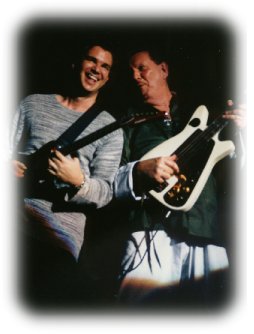
BILLY SHERWOOD: The
Conspiracy is a...
CHRIS
SQUIRE: It's all his idea (laughs).
BS: It's all my idea.
CS: I'm just along for the ride.
BS: Finally, the truth is
told.
CS: Yeah, exactly.
He does all the work; I just like...
MOT: So
you're saying that this is a Billy Sherwood solo album, and you're
a guest star?
BS:
He's guest-starring.
CS:
But he needs me (laughs).
BS: There's some sick reason...
CS: For some, sick fucking reason he
needs me like to be there, it's almost like...I don't know...the
guy says, hmmm couldn't that be the E flat?
BS: That's right. Every now and
then he's right (laughs). This was a project that started as actually
Chris's solo album back in 1989 when we first met. We started writing
songs; one of the songs that we wrote was "The More We Live", which
ended up on the UNION album, and Jon resang it and Trevor came in
and played a little bit of guitar, but there was always a magic
to the original one that we really enjoyed. So we put that on this
album, the original version of that, 'cause I know people have bootlegs
of it, and by now they've got third, fourth-end generation copies,
so we wanted them to hear it the way we heard it.
CS: Yeah, the Tom Fletcher mix.
BS: Tom Fletcher mixed that
with us, really good one, and after that song we started writing
more songs--"Love Conquers All", which found its way to the box
set YESYEARS, and "Say Goodbye", which was the song that I reworked
for one of the albums on World Trade that I worked on, but the original
version had something to it, so we put that on this album, and then
after, you know, years rolling on we wrote a lot of songs together,
and as we started working on it we turned it into the Chris Squire
Experiment, which is what we toured in 1990-whatever that was; you'll
have to look, I'm not sure.
MOT: Right, right.
CS: Delusions of Jimi Hendrix,
I had.
BS: (Laughs) So
we did that Experiment tour, and then after that the TALK tour came
up, and more songs were written, and there were a few more songs
in the can that we had written that we weren't doing anything with,
and then KEYS TO ASCENSION came. We kept writing, we kept writing,
and we wrote music all the way through OPEN YOUR EYES that kept
going on the shelf, and it was after OPEN YOUR EYES where we started
talking about, we should really put this together as some sort of
off-shoot band of Yes, if you will, like a spin-off and call it
Conspiracy, since it's the two of us conspiring over all these years
trying to get this music together, and in that way we could bring
in other musicians that we liked and wanted to work with, you know
lay it on the album...
CS:
Jay Schellen...
BS: Jay
Schellen on drums, Michael Bland cut a track with Chris and Steve
Stevens that we ended up working on together, Jimmy Haun plays a
little bit on it, and Steve Porcaro, and Alan White is on a few
tracks, so there was this kind of thing developing where it was
more than just Chris's solo album, you know, and when we talked
about it and finally arrived at the name, one of the things we talked
about was is that it would be silly to really have this be a Chris
Squire solo album because FISH OUT OF WATER had such a specific
style and flavor, but this was really miles away from that--a different
style, a different flavor, and FISH OUT OF WATER II is very much
in his potential if he wants to do that, but in terms of Conspiracy...
CS: If we could just get
the London Symphony Orchestra back together again...(laughs)
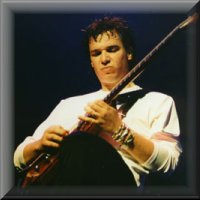 BS:
(Laughs) It was really taking on more than just a solo album from
either one of us; it was his solo album, it was my solo album, we
pushed them together, and now it's become this Conspiracy project
which we finally got finished and mastered and artworked and wrestled
with the legal departments of various companies to be able to get
it out, it seemed that through the process of that, that things
were working against us to get it out--we would have a deal, and
then it wouldn't be there, and then we'd have, you know, this song
would be finished, uh it's not quite good enough yet we got to go
back and fix it...as we started nearing the end of this, we had
the artwork together, and the guy who was doing the artwork, Chuck
Wright, a really good artist, I went over to his house and we put
all of these ideas into his computer, he pulled the artwork together,
his computer was stolen the next day and he didn't makes safeties...
BS:
(Laughs) It was really taking on more than just a solo album from
either one of us; it was his solo album, it was my solo album, we
pushed them together, and now it's become this Conspiracy project
which we finally got finished and mastered and artworked and wrestled
with the legal departments of various companies to be able to get
it out, it seemed that through the process of that, that things
were working against us to get it out--we would have a deal, and
then it wouldn't be there, and then we'd have, you know, this song
would be finished, uh it's not quite good enough yet we got to go
back and fix it...as we started nearing the end of this, we had
the artwork together, and the guy who was doing the artwork, Chuck
Wright, a really good artist, I went over to his house and we put
all of these ideas into his computer, he pulled the artwork together,
his computer was stolen the next day and he didn't makes safeties...
CS: By the ex-girlfriend.
BS: By the ex-girlfriend
(laughs).
MOT: Seriously?
BS: Yeah, so all of
the sudden he calls me and he says you have no artwork, and I say
oh my God, there's yet another thing, you know, so he redid the
artwork, we put it on a disc, put it in a vault, I mastered the
record with Joe Gastwirt, got the masters, put them in the same
vault, took a gun to several record companies and (laughs) threatened
them, and we got the record deal finished, and we sent the parts
off and it's [done], knock on wood, but it should be in your stores
in about four to six weeks.
CS: Now, you see, I have to tell you that Billy also during
this period of time suddenly became infatuated with, like Jobim,
and kind of like this off-like South American influence thing, and
a lot of stuff he was writing suddenly was like this groovy kind
of like South American...and then--is it "The Evolution Song"?
BS: Yeah.
CS: Yeah, that is actually a song,
but I think we actually achieved quite an amazing masterpiece...
BS: Yeah.
MOT: Masterpiece?
CS:
Yeah, it's like an amazing thing when I listen to it now we trade
off vocals together...
BS:
It sort of has "The More We Live" flavor...
CS: It's got a fuckin' like, really,
you know, huge expanse there, and you know, I think that's what
makes us both happy; we see that.
BS: I like the song so much and
was so frustrated that we couldn't get this thing rolling earlier,
because we've been talking about doing this since '89-'90, that
I ended up throwing it on World Trade's EUPHORIA record with a different
mix and different parts, and Chris wasn't singing as much of the
things...and different musicians; and then we came back to the song,
as he said, and we both listened to it and went, wow! The original
has a certain magic about it, so we worked on it more, and put it
on the record, and it is really, really one of the dynamic songs
on the album.
CS: Yeah.
BS: One of my favorite songs
on the record is actually one that Chris, Steve Stevens, and Michael
Bland recorded all the music for, and I heard the tracks later,
and came up with melodies and lyrics over the top and played some
keyboards on it, which is called "Violet Purple Rose".
CS: Or "Violent Purple Rose".
(laughs}
MOT: "Violent"?
BS: And that's a really cool, cool
song, very uptempo kind of rockin' song.
CS: You see, what's interesting about
us is that we actually do go to work as songwriters; we actually
sit together in the room, and we go, ok this song's going to be
about colors, as Billy said, the track was there and then we picked
this color thing, so we just threw everything, including "the round
wood (laughs)."
BS: Yeah,
exactly (laughs).
CS:
It's one of the most killer lyrics I've ever heard. Yeah, and it's
like we kind of wrestle with each other a bit on that, but not too
much, 'cause we're, you know, the Pisces and like fish swimming
around, we tend to swim in the same direction more than the opposite
direction, and we like what we do...in spite of me! (laughs)
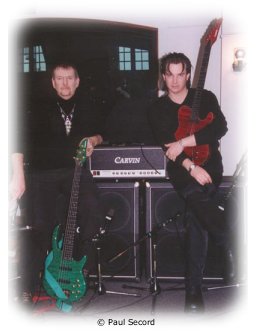 BS:
Actually we have about seven songs finished, or very close to being
finished for the next album, which we're intending to keep this
thing moving, you know, and have another Conspiracy record come
out, and those songs are really interesting as well, but this particular
collection of songs work together well because it's a mixture of
material from '89 through now. It takes you from "The More We Live"
stage, which was the first song we wrote together through extra
tracks that didn't make it to OPEN YOUR EYES, kind of thing.
BS:
Actually we have about seven songs finished, or very close to being
finished for the next album, which we're intending to keep this
thing moving, you know, and have another Conspiracy record come
out, and those songs are really interesting as well, but this particular
collection of songs work together well because it's a mixture of
material from '89 through now. It takes you from "The More We Live"
stage, which was the first song we wrote together through extra
tracks that didn't make it to OPEN YOUR EYES, kind of thing.
MOT: The way I perceive it,
from from listening to you talk is it's really more of a social
thing with you two; I mean you get together, you've pretty much
party, have fun playing together...it's not as sometimes we perceive
it as, ok we're going to sit down, we're going to record our "solo
album"...in big, grand tones...
BS: Right.
CS: I'll make this real clear right
now--he does most of the work, and I come in and fuck with it (laughs),
it's as simple as that, you know, and he goes, "Oh yeah, you might
be right about that (laughs)".
BS: He does his share (laughs).
MOT: But am I correct in that assumption,
is it just something you get together, you have fun, there's no
pressure...
BS: Yeah,
you know why, what makes it easy? I've always had environments to
make music around me, even "The More We Live", for instance, was
an environment that I had set up at my apartment, which I was living
at with my wife and a roommate, and we set up a studio in the living
room and took it over, and the creation was always available--you
could always think of something musical and record it instantly,
and as I've evolved over the last ten years, I've turned that little
recording studio into a major facility in L.A., where we made several
Yes albums and I've made a bunch of other records in there. So,
the environment has a lot to do with it, when we get together, you
know, I've got all the elements: basses, guitars, keys, studio,
drums, so when we think of something we start working on it, and
it turns into something fun to do, and then we want to get together
and work on it more, and...so, the environment has a lot to do with
it.
CS: See, not many
people probably know this, but he actually is a drummer, and he
could have been Phil Collins, because he's got that whole knowledge
of the drums, bass, guitar, keys, you know, and vocal top-line thing;
he's very talented...
BS:
But we, you know, we throw it around and let other people play instruments
(laughs).
CS: We do,
we do! Maybe, you know, we're hoping in the future we might maybe
even get Trevor Rabin involved to maybe come and join us, on some
future project, it's that open.
BS: That's why we chose, rather than calling it the Squire
Experiment, we shifted the name to Conspiracy because we've both
talked about the idea of being able to have a vehicle where every
album the two of us could choose to work with whoever we wanted
to work with, and they could become part of the Conspiracy for that
record, you know, it didn't pin it into one particular icon, it
sort of left it open to bring all kinds of great musicians in.
MOT: Also, with the Chris Squire
Experiment, from what you are saying, doesn't accurately describe
what the project's about.
BS: No, that's how it started actually...but then it
evolved, you know, it started that way, and it evolved.
CS: And then it becomes Stevie
Fred (laughs).
MOT: So, probably one question on a lot of
people's minds is how much is Chris on bass, because I know you
[Billy] play too.
BS:
He plays all the bass tracks.
CS: Do I?
BS: Yeah.
CS: No, "Man on the Moon".
BS: Well...that one particular
track maybe.
CS: And
then there's no bass on "Red Light"; that's synth bass.
BS: Well, ok, so you're
right (laughs).
CS: Featuring
my expert Neil Young style-like acoustic guitar playing, which I
must admit I do rather well (laughs).
BS: You've got the Neil grip (laughs).
CS: Yeah, I got the
Neil [emulates acoustic guitar strum sound] (laughs)
BS: Yeah, I guess you're right.
Yeah, I did play a couple of bass tracks.
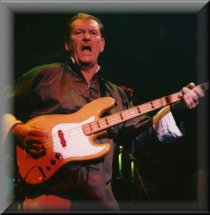 CS:
Yeah, he does. He's an all-around great guy, musician...I was telling
Jon that (laughs) [in squeaky voice] "Uh yeah, he's a great guy,
a good musician"...but you know, it's like, it's great working with
him because of his heritage he took from his father; he's obviously
inherited the genes, from a very talented musician...
CS:
Yeah, he does. He's an all-around great guy, musician...I was telling
Jon that (laughs) [in squeaky voice] "Uh yeah, he's a great guy,
a good musician"...but you know, it's like, it's great working with
him because of his heritage he took from his father; he's obviously
inherited the genes, from a very talented musician...
BS: I think it's kind of cool to
be able to work in a situation where you're open enough to walk
in and hear something and say, that's good, let's not mess with
it, I mean, there's often times a couple of these--"The More We
Live" is a perfect example, because I had just met Chris, and I
said you got to play the bass part, and he said, no I really like
this bass part you put down, and I said, but you're Chris Squire,
I'm Billy Sherwood, you've got to play this bass part (laughs),
and he said no, let's leave it on there, and I really thought, well
that's pretty nice because I did enjoy the bass part and it works
with the track...
CS:
And he let me get away with playing the keyboards.
BS: And we actually got to the
studio, and Eddie Offord said, well, Chris, you have to play this
bass track, and he said no, it's good, let's leave it, and he said,
but you're Chris Squire, and he said no, he said let's just leave
it, and so it kind of went down the chain like that, so over the
years now, I'm more used to it when he walks in and he says let's
leave it, and I say no, you're just being lazy, just play the damn
thing (laughs). But sometimes I listen back and I think that's good
that we left it like that because there is something there.
CS: Just to continue, a
thought occurred to me last night is that he and I are now playing
together on stage every night and very on a regular basis and within
the Yes camp, and we've now sort of get into these really kind of
like groovy rhythm things...it's kind of cool, which is a great
thing because not many studio musicians have the opportunity to
able to, like, display their talent in a live environment, so I
enjoy playing with him more and more, and now he gets it right
BS: (Laughs)
MOT: Well, Billy does add a lot
to all Yes compositions, of course brings something new to all the
new songs.
BS: Yeah,
well, I try my best to blend into something that's well-established
and the blueprint is pretty unchangeable, so you know, I try to
find my way in cleverly and tastefully as I think I could.
MOT: I just wanted to ask you
about Eddie Offord, was he involved in just a couple of tracks or
many tracks or what...
BS: He didn't really have anything to do with this record
at all, with the Conspiracy you're talking about?
MOT: Yes.
BS: No, he didn't anything to do
with it.
MOT: You mentioned
him.
BS: Well, because
Eddie, when we did "The More We Live", which is on this record,
and as I said you'll be able to hear it what it really was first,
he didn't change much about what it was. I transferred the tapes
and that was pretty much that. Jon came in and resang the vocal;
Trevor played a couple little bits, and that was that, and I think
it was really a case of this is a new guy, we don't know who he
is, let's give him a co-producer credit, but the reality is that
I produced that track, and Eddie was kind of more in the backseat
on that, but he was "Eddie Offord", and he took the credit, so Eddie
really had nothing to do with creating "The More We Live".
CS: No, not really.
BS: And when it came time
to do Jon's vocal, which Jon was a little hesitant about at first,
Eddie was not really a whole lot of help to me on that one, believe
me (laughs).
CS: Now,
now.
BS: Although I
love him, and we got along great, worked together well, he sort
of said you handle it, so... (laughs)
CS: While we were saving ABWH at the
time.
Huge budget.
MOT: "The More We Live", the version that
does appear on the Conspiracy album, is the one that you recorded
years ago without any additional overdubs or editing.
BS: Well it's got a lot of
the elements...you know it will be interesting because I'm sure
that fans who love that song, as a lot of people have told me they
do, will get to hear where it changed, and it's--the changes are
subtle, I mean, one of the obvious changes is Jon singing it on
the album UNION, and then I'm singing it on this album with Chris,
and there's much more interaction between Chris and I. In terms
of overdubs, I don't think you're going to notice many overdubs
differences.
CS: No.
Also, of course, that there's a weird thing, call me a Mingus if
you like, I have a keyboard feel; I'm not a great technician, and
I have, keyboard, I did it on "Run Through the Light" on the DRAMA
album, and on "The More We Live" too, like this more "feel" thing
I have going, but I remember him at the beginning going, are you
sure you want to play keyboards; everybody always says that to me,
but lately he's gotten to like it...
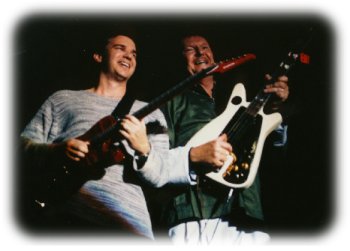 BS:
He came over with [sings part of the song], and he split, and I
said I don't know what I'm going to do with this (laughs). I started
working on it a bit and then I came up with this concept of the
more we this, the more we that, and all of the sudden it started
evolving, and that keyboard thread became a very important part
of the whole thing.
BS:
He came over with [sings part of the song], and he split, and I
said I don't know what I'm going to do with this (laughs). I started
working on it a bit and then I came up with this concept of the
more we this, the more we that, and all of the sudden it started
evolving, and that keyboard thread became a very important part
of the whole thing.
CS:
Yeah, little keyboard fill...
BS: But it didn't hit me until way later...(laughs)
CS: He caught up.
BS: And one of the actual
songs that I really enjoy listening to now...
CS: He's used to working with, like
Steve Porcaro, people that do everything, and here I come with [sings
part of "The More We Live"]...
BS: One of the songs that is on the record that I like
listening to, now that it's complete, is called "Red Light", which
is a song Chris had that we worked on in 1989, around the same time
as "The More We Live", and I was just not a big fan of this song;
it was not hitting me. It took him about seven or eight years to
get me to relook at the song, but then we took a different approach
to it, rather than...
CS:
Yeah, he found guitar parts...(laughs)
BS: Well, we just created a rhythmical
vibe that wasn't quite the same as it was when we did it at Cherokee
with Tony Kaye and Alan, myself, and Chris...it became more ethereal
and more atmospheric in its production; the bass part became much
more mellow and soothing, and it really sounds good. It actually
is one of my favorite things to listen to on there.
CS: It's a pretty dreamy thing.
BS: And it took a long time
to see it. He has a way of seeing things a certain way.
CS: Thank God!
BS: Which are good
CS: Because otherwise he'd dump
me! (laughs).
BS: Often
times it takes me a little while to start seeing it--to being in
on it.
CS: ...otherwise
it's "what the fuck am I doing with this guy!" (laughs). Yeah we
swim around on the Piscean ocean; it's good though most of the time
now we're working together we're kind of like go, yeah, that's good,
let's do it then...
BS:
That's the good thing about it; we both look at each other, and
we're easily...yeah, are we good with that? Yeah, is it a closed
issue? Yeah, ok good, I can live with that. I know that in Yes it's
a bit of a struggle, but because there's more people obviously,
but with just with the two of us we seem to find agreement pretty
easily in the music.
MOT:
Any future Conspiracy projects will pretty much all have the same
tact--it's kind of a casual thing, get-together, you make music...
BS: Right at the moment
we're extremely happy, I'm sure he is as much as I am, to be able
to say that this thing is finally coming out.
MOT: And it [the album] is called CONSPIRACY.
BS: And it's called
CONSPIRACY, and as I said the plan is to not go another ten years
before there's another album, and we've already got seven songs
in the can for the next one, and I think that for the fact that
it's up and running, it will take care of itself in its momentum,
and it will keep moving forward. Now that it's real and it's viable,
we're definitely going to stay at it and have another vehicle to
make great music outside of Yes, cause Yes could never do all of
the music that's available, that's for sure.
MOT: I take it this is basically a recording
kind of project.
BS:
Not necessarily, we toured this thing as the Chris Squire Experiment...
MOT: That was years ago when
Yes was kind of in limbo.
BS: Yeah, well, and Yes is one of those situations where
you just never know when there's gonna be a break, but if there
is a substantial break, we've talked about touring, and it's not
nearly as complex and logistically a nightmare to get what we do
outside of this up and running, as it is to get Yes up and running,
so the potential of having three months off and saying, hey, let's
tour for a month, it's much more real than saying that around Yes,
when Steve lives in England and Alan's in Seattle; we both live
in the same city, so it's much more easy to coordinate...
CS: Yeah...and you're moving
to New York I hear...(chuckles)
BS: Yeah...(laughs) not any time soon...
CS: Well, I hear you're working
there soon.
BS: I'll
be working there soon...
CS: Oh yeah.
MOT: Then it could be more of an impromptu
type of thing where you'll go to like Hawaii or somewhere like you
did before, or play just local clubs.
BS: You never know, we might do
a House of Blues tour (laughs).
CS: You never know; it's like...interestingly
enough Trevor Horn is touring with Art of Noise, and U2's manager
is managing that. I could see...you know, let me put it this way.
I got used to success in the 70's, gotten used to the dip, gotten
used to the big peak again with 90125, so success is good...and
I'm always hoping that that will come around again, you know it's
not like, I know I'm not a one-time success guy; I think that success
is the important thing that we're looking for, and we want to do
something where people go. "Fuck! Who did that fucking song?" Chris
Squire and Billy Sherwood...and then we'll go to Spago, and I like
to have a nice dinner and Wolfgang will cook for us personally and
it'll be great (laughs).
BS: Hey hey, there you go.
MOT: Are you looking for any commercial
channels to play the album?
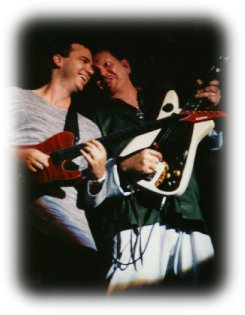 BS:
We would not be opposed if anyone was to want to take upon themselves
to start playing songs on the radio, but at the same time, we're
not sitting back stressing on whether or not we're going to get
radio; this was a project that started out of the love of the music,
and has evolved and continued out of that, and this album was just
a culmination of all those years trying to figure out what we were
going to do. Now that we've got it sorted out, this album sets the
first stone, and in terms of commercial success, if it happens,
great, if it doesn't, that's ok cause we're planning on another
album as well, but...the songs are very accessible.
BS:
We would not be opposed if anyone was to want to take upon themselves
to start playing songs on the radio, but at the same time, we're
not sitting back stressing on whether or not we're going to get
radio; this was a project that started out of the love of the music,
and has evolved and continued out of that, and this album was just
a culmination of all those years trying to figure out what we were
going to do. Now that we've got it sorted out, this album sets the
first stone, and in terms of commercial success, if it happens,
great, if it doesn't, that's ok cause we're planning on another
album as well, but...the songs are very accessible.
CS: I have a good feeling about
it, I have a good feeling that suddenly...or slowly--
BS: The songs are much more accessible
than maybe anything I'd work on my own or he'd work on his own.
MOT: Right now it seems to me
that with this particular album, obviously the core fan-base is
going to be Yes fans. It sounds to me like you'd like to see it
break beyond that.
CS: I think the music goes beyond
that. I think the music could, if marketed properly and played in
some of the right areas, it could catch on, a bit like those Spanish
monks...
BS: The Macarena.
CS: Yeah, or the Macarena
guys...look at those guys.
MOT: It's just a matter of timing...having
it be at the right place at the right time.
BS: Yeah.
CS: But the music, however, is pretty
timeless, actually.
BS:
It is; I mean, tracks from 1989 mix just as well with these tracks
from today, and the way the album is sequenced, it's...you couldn't
tell which one was written when or when it was recorded, so it is
kind of timeless in its essence.
MOT: I'm sure a lot of Yes fans are going
to be very interested in hearing it, and good luck; I really hope
that it breaks out of that mold.
BS: The label is Eagle Rock, everywhere
in the world, except North America, where it's Purple Pyramid/Cleopatra,
and we'll see what they do with it. Well, hopefully they'll get
it out there. I know there going to put it in stores, beyond that
if they do anything else, that'll be a surprise to both of us, but
the music should be the thing that speaks, and tells it how far
it's really gonna go.
MOT:
Anything you want to say, possibly in closing, about the album itself;
any tracks that you are particularly proud of?
CS:
Actually all of them.
BS:
They're all very good. We actually left a couple off that we didn't
think were up to snuff, but the stuff that we really liked is on
there.
MOT: Are there any
"epics"?
BS: No,
it's not really geared in that Yessy vein of, oh man, we better
have that eight minute song. It's just songs, and if they felt like
let's keep going, we kept going; if it felt like let's end this
thing, we ended it.
CS:
It's funny one day, Billy being of the Jewish persuasion, I kind
of said to him, let's do, like, the Lord's Prayer, and he went,
I don't think we could do the whole thing.
BS: I wanted to read the Torah.
(Chuckles)
MOT: (Laughs)
CS: So, one of the tracks actually
has the words "on earth as it is in Heaven", which is like a little
quote from that, and every time I hear it, it's very glorious, actually.
BS: Yeah, it is nice. With
the odd time moving against it...yeah it's cool.
CS: And both of us are detail guys,
like let's put piano in there with the bass, so we really enjoy
what we do.
BS: I think
it's produced very sonically interesting for the listener too.
MOT: And musically very creative.
BS: Very creative and
the colors are great; the textures are great. He's singing really
good; I'm trying to sing as good as I can, and I think that it's
a very well rounded album. You get to hear a lot of Chris singing,
which is good, cause I know Yes fans want to hear that as well as
other people who don't know Yes...it's a very interesting textured
voice.
MOT: It is a highlight,
even during the shows, even though it's a harmony vocal. I know
I look forward to hearing Chris sing.
BS: So, I think it's a good platform
for us both to be able to have a vehicle to create other music as
well as, he's got solo works; I've got solo works. This thing together
is definitely a conspiracy.

 Visit
the Conspiracy page
Visit
the Conspiracy page